Vietnamese Woven Rugs: Fibers, Weaves and Sizes for Buyers
9 Nov 2026A Vietnamese woven rug is a flat, handwoven floor covering made from local plant fibers, most often seagrass, water hyacinth, corn husk leaf or palm leaf, woven by hand rather than tufted or machine made. For wholesale buyers the practical differences come down to three things: which fiber is used, how the rug is constructed, and which format you are buying. This guide covers all three, along with the questions worth asking before a first order.
Key takeaways
- Vietnamese woven rugs are made from four main plant fibers. Each one behaves differently underfoot and in the carton.
- The craft is centred on sedge growing districts in northern Vietnam, where mat weaving on hand looms goes back centuries.
- Four formats cover most retail demand: area rugs, round rugs, runners and doormats.
- Natural fiber rugs belong indoors. Damp conditions, not daily foot traffic, are what shorten their life.
What makes a Vietnamese woven rug different from a tufted rug?
A tufted rug is built by pushing yarn through a backing cloth. A woven rug of the kind made in Vietnam has no backing: the fiber itself is the structure. Strands are plied or braided, then interlaced on a loom or coiled and stitched into a panel. Nothing holds the rug together except the weave, which is why construction matters more here than it does in a tufted product.
That also explains the look. The fiber cannot be dyed in the way wool or cotton can, so colour comes from the plant and from how it was dried. Most of what you see in a natural fiber rug is a range of straw, honey and warm brown tones, with pattern created by alternating fibers rather than by printing.
Which natural fibers are used, and how do they differ?
Four fibers do most of the work. Combining two of them in one rug is a design approach Viet Trang uses often, because it creates tonal stripes and texture that a single fiber cannot. If you want the fuller material comparison, our guide to the differences between water hyacinth and seagrass goes deeper on the two most common ones.
| Fiber | Character underfoot | Typical rug use |
|---|---|---|
| Seagrass | Smooth and firm, with a slight sheen | Area rugs, runners, round rugs, doormats |
| Water hyacinth | Softer and warmer, distinctly brown | Area rugs and rugs for bedrooms and living rooms |
| Corn husk leaf | Pale and milky, light in tone | Stripes and contrast bands within a mixed rug |
| Palm leaf | Flat and smooth with a clean finish | Light coloured patterned details and borders |
Corn husk leaf deserves a note. It is recycled from leftover leaves after the corn harvest, so a rug that uses it is putting a farm by-product to work rather than consuming a crop grown for the purpose.

Where does the craft come from?
Rug and mat weaving in Vietnam is tied to the places where sedge grows. Nga Son in Thanh Hoa province is one of the best known. Published accounts of the village describe a craft passed down for over three centuries, mats once chosen as tribute to the royal court, and an export trade that ran to the Soviet Union and Eastern Europe before shifting to markets including Germany, Japan, South Korea and the United States.
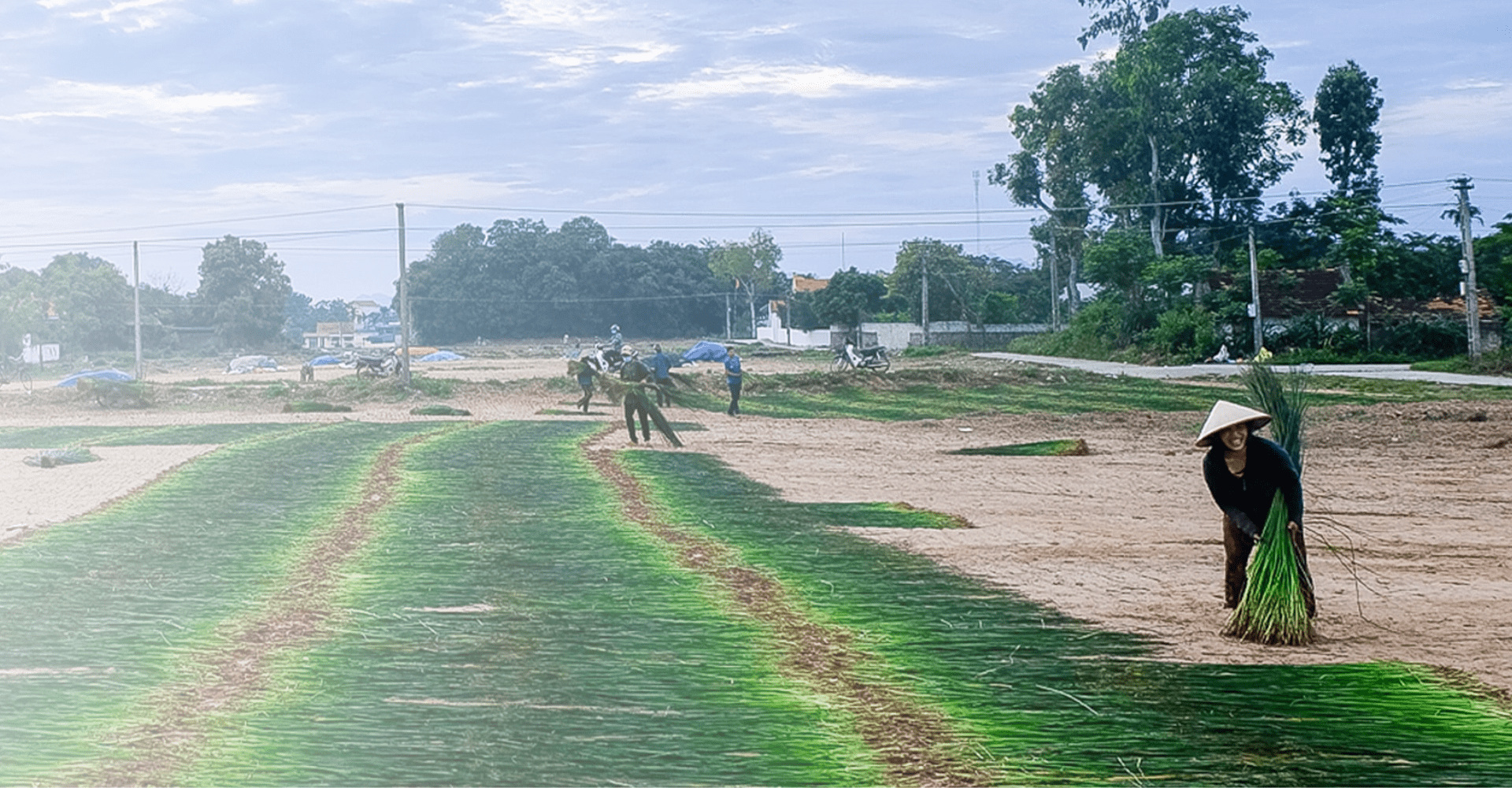
The growing conditions are part of the story. Nga Son sits on coastal, brackish land where tidal silt reaches the fields, and local accounts describe the sedge grown there as finer and longer than sedge from other regions, with a natural golden sheen. Growers usually take two crops a year, one in June and July and one in October and November. Our own account of the village is in Inside Nga Son.
Viet Trang has woven rugs in Nga Son for more than fifty years, which is longer than any other category we make.
How are the rugs actually woven?
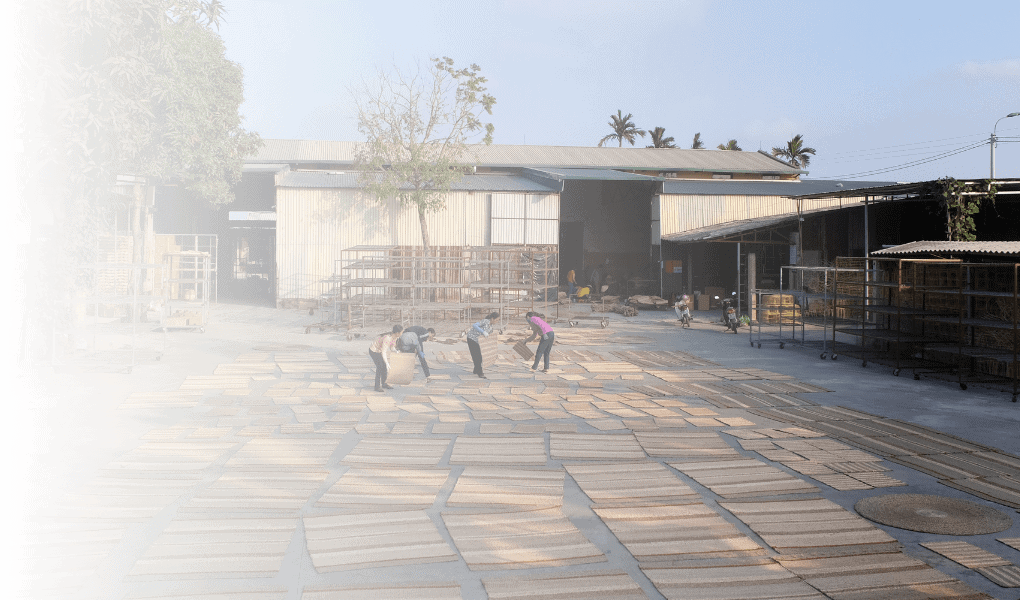
After harvest the stalks are sorted, split lengthways by hand and laid out to dry. Drying is the step that decides quality. Published descriptions of Vietnamese sedge weaving put it at roughly three to four days of the right sunlight: too much and the fiber turns brittle, too little and it risks mould later.
The loom itself is a wooden frame worked by two people. One holds the warp taut and lifts sets of threads to open the shed, the other passes a strand of sedge through and packs it into place with a wooden reed, strand by strand. Patterns are not printed on afterwards. They are woven in by alternating fibers as the rug grows. Braided and coiled rugs are made differently again, with lengths of plaited fiber stitched together into circles or panels.
Which formats should you stock?
Four formats cover most of what retail buyers ask for. The practical difference between them is less about style than about what has to be stated on the specification sheet, because a handwoven rug is made to the dimensions you agree rather than cut from a roll.

We also make foldable runners and foldable area rugs, which are woven in panels so the rug folds down for shipping and for storage at home. If rugs and runners in seagrass are your main interest, our seagrass rugs and runners buyer guide is the companion piece to this one.

How durable are natural fiber rugs, and where should they not go?
Daily foot traffic is rarely the problem. Seagrass in particular is a firm, non-porous fiber, which is why it is often recommended for entryways and busy rooms, and why spills tend to sit on the surface long enough to be blotted up rather than soaking in. Retailers of natural fiber rugs do warn that strongly coloured liquids such as red wine or tomato sauce can still mark the fiber.
Moisture is the real limit. Rain and sustained humidity will damage a natural fiber rug, so these are indoor products. A covered porch can work in a dry climate if the rug comes in when it rains, but a bathroom, a laundry room or an open balcony is the wrong place for one. Care is simple: vacuum with suction only and no beater bar, and blot spills rather than rubbing them. We cover this in more detail in our guide to cleaning and caring for seagrass and water hyacinth homeware, which doubles as a care card you can pass to your own customers.
What should you check on a rug sample?
Six things tell you most of what you need to know when the first sample arrives.
- Measure it. Compare the finished size against the specification and agree the tolerance in writing, because every piece is woven by hand.
- Look at the edges. A bound or stitched edge is what stops a flat woven rug fraying in use.
- Check where panels meet, if the rug is made in panels. The join should sit flat with no ridge.
- Press the weave with your thumb. It should spring back rather than stay compressed.
- Smell it and feel it. Fiber packed before it was fully dry smells musty, and that smell is a warning about the whole shipment, not the one piece.
- Put it on the floor and walk on it barefoot. Texture is the thing your customer judges first.
Custom sizing is available across most of our rug range, so if a standard size does not suit your market, send the dimensions you need. A good example of the mixed fiber approach is our handwoven seagrass and corn husk leaf area rug, where the pale corn husk is what creates the stripe.
Vietnamese woven rugs from our range
All four pieces below are handwoven rugs from our own range, covering area rugs in three fiber combinations and one runner.


Frequently asked questions
What is a Vietnamese woven rug made of?
Most are made from seagrass, water hyacinth, corn husk leaf or palm leaf, or from a combination of two of these. The fibers are grown and processed locally, split, dried and then woven by hand.
Are natural fiber rugs durable enough for a living room?
Yes. Seagrass in particular is firm and hard wearing, and is often recommended for entryways and busy rooms. The limiting factor is moisture rather than foot traffic.
Can a woven rug be used outdoors?
We do not recommend it. Rain and sustained humidity damage natural fiber. A covered porch in a dry climate can work if the rug is brought inside when the weather turns.
Can you make rugs in our own sizes?
Yes. Custom sizing is available across most of the rug range, and our design team can also work from your sketches or references. Send the dimensions and the fiber you have in mind and we will confirm what is possible.
What is the minimum order for rugs?
It depends on the design, the size and the fiber, so we confirm it against your specification rather than quoting one figure for the whole range. Send us what you need and we will come back with the detail.
Looking at rugs for your next assortment?
Tell us the formats, sizes and fibers you have in mind and we will send a quote, arrange a sample or set up a video call from the factory floor in Nga Son.

To receive lots of incentives with dedicated and professional service...
Or view more handwoven product in our
lookbook collection
CONTACT NOW
+84 915 709 666
(WhatsApp available)