Woven Napkin Rings: The Small Line That Lifts a Table Range
25 Nov 2026A woven napkin ring is a small braided or coiled band of natural fiber, usually 4 to 5 cm across the opening, sold in multiples of four or six. For a buyer it is one of the cheapest ways to make a table range feel designed rather than assembled, and it is an easy add on at the till. The specification that matters is short: inside diameter, how the cut ends are finished, colour consistency across the pack, and how many rings are in that pack.
Key takeaways
- Entertaining at home is holding up. In the 2027 IHA At-Home Entertaining Survey, 56 per cent of US consumers hosted a casual gathering in the past year, and 24 per cent expect to host more often in the next twelve months.
- Reusable is gaining on disposable. Everyday housewares were the choice for 27 per cent of hosts, up from 24 per cent, while disposables slipped from 44 to 42 per cent.
- Specify the inside diameter, not the outside one. A napkin ring that will not take a folded cotton napkin is returned, however pretty it is.
- Sell them beside placemats, runners and trays rather than on their own. The ring is the piece that completes a set, not the piece that starts one.
Why put woven napkin rings in a 2027 range?
Because the occasions are still there and the budget behind them has moved. The 2027 HomePage News At-Home Entertaining Report, built on the International Housewares Association survey run by Morning Consult in October 2026 among 2,253 US adults, found that 56 per cent of consumers had hosted a casual gathering in the previous twelve months and the same share had hosted an occasion based gathering. Looking forward, 24 per cent expect to host more often and 45 per cent about the same amount. Among Gen Z and Millennials the share expecting to host more rises to roughly 35 per cent each.
What has changed is the money. Lower costs or more affordable options was the top motivator for hosting, named by 42 per cent, ahead of spending time with family and friends at 41 per cent. That is a shift from the previous year, when affordability sat third. For a buyer this points at small decorative pieces rather than large ones: the host who will not buy a new dinner service will still buy something that makes the table look considered.
Two more numbers from the same survey are worth having in a range review. Tableware moved up as a pre party purchase, with 17 per cent of consumers saying they always need to buy some and 21 per cent usually, against 16 and 18 per cent a year earlier. And about seven in ten consumers said sustainability was at least somewhat important when choosing products for entertaining, 24 per cent calling it extremely important and 47 per cent somewhat important. A plant fiber ring in its natural colour answers both of those at once.
The category itself is not small. Grand View Research sized the North America tabletop kitchen products market at USD 14.54 billion in 2025, with USD 22.51 billion forecast by 2033.

What separates a good woven napkin ring from a bad one?
This is a piece where small faults are visible at arm’s length, because it sits next to a white napkin under good light. Five things decide it.
| What to check | What good looks like | Why it matters |
|---|---|---|
| Inside diameter | Consistent across the pack, wide enough for a folded cotton or linen napkin | The commonest reason a ring is returned. Quote the inside measurement, never the outside. |
| Finish of the cut ends | Ends tucked, braided back or bound, with nothing standing proud | A loose end catches on fabric and pulls a thread out of the napkin. |
| Colour consistency | Rings within one pack matched for tone, with natural variation across packs explained on the label | Natural fiber varies by harvest. Set the expectation rather than hiding it. |
| Wall thickness and weight | Even all the way round, light enough to sit on a napkin without crushing it | An uneven wall makes the ring sit crooked on the plate. |
| Pack multiple | Four or six, matched to how the market lays a table | Four suits everyday, six and eight suit hosting. A pack of five sells to nobody. |
All of our table pieces are woven from plant fiber in its natural colour, with no synthetic dyes, and the fibers used for kitchen and dining are chosen for surface smoothness because they sit against food and fabric. That is a design constraint rather than a slogan: a coarse weave that is right for a floor basket is wrong on a table.

Which fiber should a table piece be woven in?
For napkin rings we mostly use palm leaf, seagrass, or the two together. Palm leaf is split, braided and woven by hand using traditional techniques that give smooth edges and a clean pale surface, which is why it carries the white and light patterned details in our range. Seagrass, grown in Nga Son and harvested locally, is smooth and slightly silky with a tone that runs from light straw to warm brown.
Combining two fibers in one piece is a Viet Trang signature, and on something as small as a napkin ring it is the whole design: a pale palm leaf band striped against darker seagrass reads clearly from a metre away, which a single fiber ring does not. If your table story is tonal and quiet, ask for one fiber. If it needs to photograph, ask for the stripe.
How should they be packed, labelled and priced to sell?
Decide between open stock and a boxed set early, because it changes the packaging cost more than the product cost. Open stock in a tray, priced per ring, suits shops where customers build their own table; a boxed four or six, with a window or a belly band, suits gifting and suits the November to December weeks, when 66 per cent of hosts run a Thanksgiving or Friendsgiving gathering and 59 per cent a Christmas or Hanukkah one.
Then settle the mechanical details in the same conversation: barcode per pack or per piece, hang tag or belly band, the exact wording of the material and country of origin line, inner and outer carton counts, and whether a care note goes in the box. Small items are where carton counts go wrong, and a wrong inner count is a receiving problem in every store you ship to.

How do napkin rings earn their shelf space?
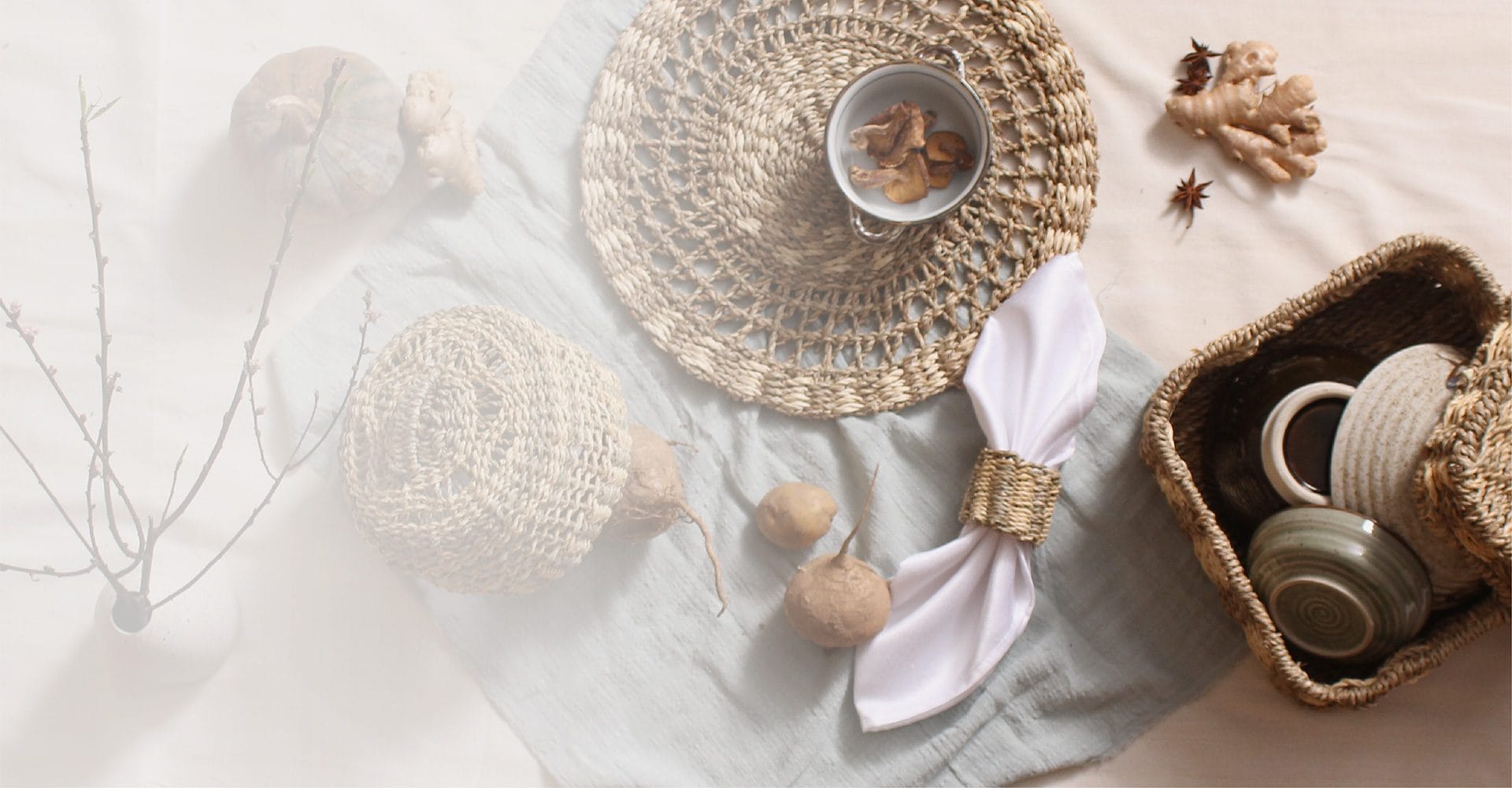
Not on their own. A ring is the last piece of a table, so it sells when it sits beside the pieces that come first. The pairing that works in our customers’ stores is a placemat, a runner, a serving tray and the rings, in one fiber story and one tone, photographed together once and then merchandised together on the shelf. Our guides to woven placemats and woven serving trays cover the two anchor pieces in that group, and the assortment guide covers how to balance a natural homeware range across categories without ending up with four versions of the same thing.
There is a practical reason for grouping them too. The survey found table setting and decorating ideas rising as a source of inspiration that encourages people to host, at 17 per cent. People are copying a complete table, not buying a single ring. Give them the complete table to copy. You can see the current table pieces in the placemats and table accessories part of the catalogue, including the palm leaf and seagrass napkin holder that works as a serving piece alongside the rings.
What should you settle before you order?
Five points. The inside diameter in centimetres, with a tolerance you can accept. The pack multiple and whether it is open stock or boxed. The fiber, single or combined, and the tone you expect, agreed against a physical sample rather than a photograph. The labelling and carton counts. And the sample itself: ask for it with a napkin of the weight your market sells, because a thin cotton napkin and a heavy linen one need different openings.
Custom sizing is available across most of our categories, and our design team can develop a shape from your sketch or mood board and send a sample for approval before production. For a small accessory, that sample round is quick and it is the only reliable way to agree a tone.
Woven napkin rings from our range
These four are the napkin rings currently in production. Each product name states its own material, and the one named simply as natural is woven in natural fiber without the fiber being specified in its name.


Frequently asked questions
What size should a napkin ring be?
Specify the inside diameter rather than the outside. As a rule of thumb a ring in the 4 to 5 cm range will take a normally folded cotton napkin, but heavier linen needs more room, so test the sample with the napkin your market actually sells.
Are woven napkin rings washable?
They are not washed like fabric. Natural fiber wants dry handling: brush off crumbs, wipe a mark with a barely damp cloth and let the piece dry in moving air. A care note in the pack prevents most of the complaints in this category.
Can we order napkin rings in a custom colour?
Not in a dyed colour. We weave plant fibers in their natural hues and do not use synthetic dyes, so the palette comes from the fibers themselves and from combining a pale fiber with a darker one. If you need a specific tone, we match it against a sample.
What pack sizes can you supply?
Four, six and eight are the usual multiples, and the choice is driven by how your market lays a table rather than by production. Tell us the multiple, the inner and outer carton counts and the labelling you need, and we will quote to that.
Can you make a matching placemat and runner?
Yes, that is how most of our table ranges are developed. The kitchen and dining range covers placemats, runners, trays, bread baskets, bowls, napkin rings and food covers, so a group can be woven in one fiber story and one tone.
Building a table range for next season?
Send us the diameters, pack multiples and the tone you are working to, and we will quote and send samples. If it is easier to see the weaving first, we can set up a video call from the factory in Nga Son.

To receive lots of incentives with dedicated and professional service...
Or view more handwoven product in our
lookbook collection
CONTACT NOW
+84 915 709 666
(WhatsApp available)